Sieve of Eratosthenes:
Sieve of Eratosthenes is used to get all prime number in a given range and is a very efficient algorithm.
Sieve of Eratosthenes is used to get all prime number in a given range and is a very efficient algorithm.
Following is the algorithm to find all the prime numbers less than or equal to a given integer n by Eratosthenes’ method:
- Create a list of consecutive integers from 2 to n: (2, 3, 4, …, n).
- Initially, let p equal 2, the first prime number.
- Starting from p2, count up in increments of p and mark each of these numbers greater than or equal to p2 itself in the list. These numbers will be p(p+1), p(p+2), p(p+3), etc..
- Find the first number greater than p in the list that is not marked. If there was no such number, stop. Otherwise, let p now equal this number (which is the next prime), and repeat from step 3.
Explanation with Example:
Let us take an example when n = 50. So we need to print all print numbers smaller than or equal to 50.
Let us take an example when n = 50. So we need to print all print numbers smaller than or equal to 50.
We create a list of all numbers from 2 to 50.
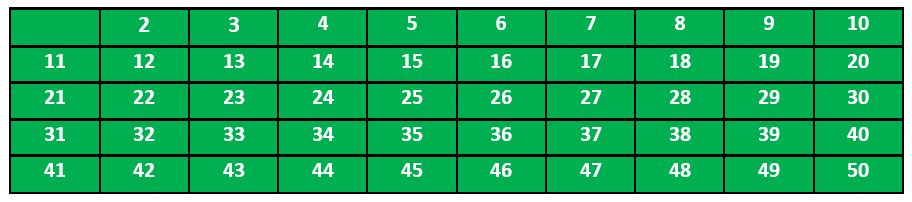
According to the algorithm we will mark all the numbers which are divisible by 2 and are greater than or equal to the square of it.
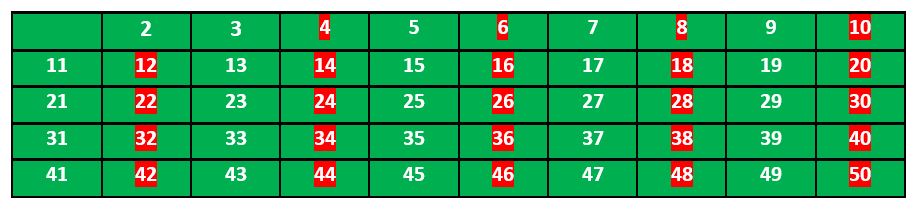
Now we move to our next unmarked number 3 and mark all the numbers which are multiples of 3 and are greater than or equal to the square of it.
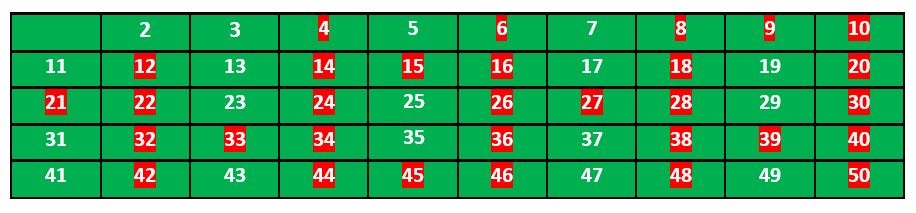
We move to our next unmarked number 5 and mark all multiples of 5 and are greater than or equal to the square of it.
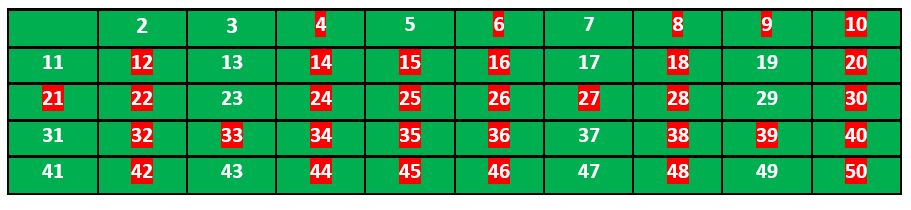
We continue this process and our final table will look like below:
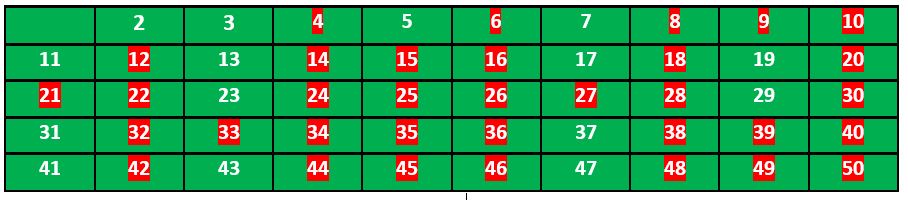
So the prime numbers are the unmarked ones: 2, 3, 5, 7, 11, 13, 17, 19, 23, 29, 31, 37, 41, 43, 47.
BELOW IS THE PROGRAM OF THE ALGORITHM::
# Python program to print all primes smaller than or equal to
# n using Sieve of Eratosthenes
def SieveOfEratosthenes(n):
# Create a boolean array "prime[0..n]" and initialize
# all entries it as true. A value in prime[i] will
# finally be false if i is Not a prime, else true.
prime = [True for i in range(n+1)]
p = 2
while (p * p <= n):
# If prime[p] is not changed, then it is a prime
if (prime[p] == True):
# Update all multiples of p
for i in range(p * p, n+1, p):
prime[i] = False
p += 1
# Print all prime numbers
for p in range(2, n):
if prime[p]:
print p,
# driver program
if __name__=='__main__':
n = 30
print "Following are the prime numbers smaller",
print "than or equal to", n
SieveOfEratosthenes(n)
Output:
Following are the prime numbers below 30
2 3 5 7 11 13 17 19 23 29
The sieve of Eratosthenes can be expressed in pseudocode, as follows:
Input: an integer n > 1.


No comments:
Post a Comment
if you have any doubt please let me know.